1. The Landscape of Women's Business Attire in Indonesia
Indonesia's corporate ecosystem is undergoing a historic transformation. Driven by the rapid growth of the service sector, digital finance, and government-backed industrial initiatives, the presence of female professionals in executive and leadership positions has reached record levels. In major hubs like Jakarta, Surabaya, Bandung, and Medan, the demand for high-caliber women's business attire has shifted from standardized uniforms to sophisticated, functional, and culturally respectful business wear.
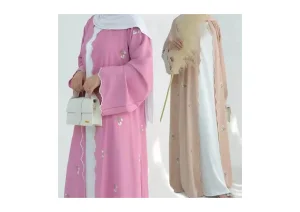
Developing corporate apparel for the Indonesian demographic requires a deep understanding of local cultural preferences. Chief among these is the integration of modest fashion. Approximately 87% of the Indonesian population identifies as Muslim, creating a robust market for corporate-grade modesty wear. Modern female professionals seek garments that offer complete coverage—long sleeves, modest necklines, and non-restrictive cuts like Baju Kurung styles and structured tunics—without compromising on elegance, professional authority, or heat regulation.
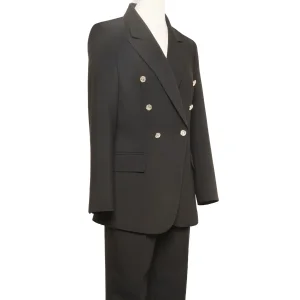
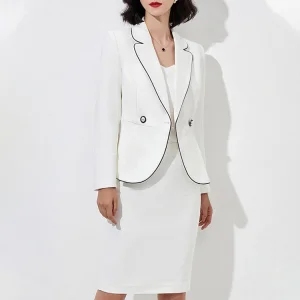
Furthermore, Indonesian business culture places great emphasis on regional textile heritages, such as Batik. Modern corporate apparel programs must seamlessly blend Western tailoring standards (such as crisp blazers, structured pencil skirts, and tailored trousers) with local styling preferences. Suppliers who can offer modular design packages that accommodate these cultural realities have a distinct advantage in bidding for major Indonesian corporate accounts.
2. Technical Textile Demands: Navigating Tropical Climates
Indonesia is characterized by its tropical rainforest climate, with high humidity and temperatures consistently averaging between 28°C and 34°C throughout the year. For office professionals navigating commutes in hot metropolitan environments and transitioning to heavily air-conditioned corporate offices, clothing thermodynamics is a critical performance metric. Standard heavy-wool suits or cheap, non-breathable polyester garments are highly unsuitable, leading to discomfort, skin irritation, and premature wear.
At Setor Fashion, we solve these environmental challenges through technical fabric innovation. We formulate advanced blends optimized specifically for tropical business applications:
| Fabric Blend Code |
Composition & Structure |
Target GSM (Weight) |
Primary Performance Advantage for Indonesia |
| TR-Breeze 240 |
65% Polyester, 32% Viscose, 3% Elastane |
220 - 240 GSM |
Highly breathable, high-drape fabric that mimics natural wool while offering active cooling properties. |
| HydroFlex Multi-Stretch |
78% Micro-Polyester, 18% Rayon, 4% Spandex |
180 - 200 GSM |
4-way active stretch with moisture-wicking and rapid-dry finish, ideal for high-humidity commutes. |
| Eco-Cool Tencel Blend |
50% Tencel, 47% Organic Cotton, 3% Spandex |
210 GSM |
Exceptional softness, natural hypoallergenic properties, and eco-friendly footprint. |
| Shield-Guard TR |
70% Polyester (Anti-Wrinkle), 30% Viscose |
250 GSM |
Permanent press, high-twist yarn construction. Resists wrinkles through long travel days. |
By utilizing high-twist yarn structures and open-weave configurations, we ensure that air circulation is maximized without sacrificing the structure, opacity, and professional look of the suit. This thermodynamic adaptability is essential for corporate uniforms in sectors like banking, aviation, and hospitality across Indonesia.
3. Sourcing & Procurement Solutions for Indonesian Corporates
Large-scale procurement officers at Indonesian state-owned enterprises (BUMN), private banks, and multinational companies face complex supply chain dynamics. Key challenges include maintaining consistent dye lots across multiple production runs, accommodating sizing variations within large workforces, and managing long-term logistics costs.
As a strategic OEM/ODM partner, Setor Fashion offers integrated solutions to mitigate these procurement risks:
- Bespoke Pattern Engineering: We use advanced 3D body modeling and CAD systems to develop grading matrices that fit Southeast Asian body profiles perfectly, reducing the need for costly post-delivery alterations.
- Flexible MOQ & Scale Integration: Our factory handles both low-volume bespoke executive lines (as low as 100 pieces per style) and high-volume mass production runs (exceeding 50,000 pieces).
- Dye-Lot Integrity Assurance: Utilizing computerized spectrophotometers, we guarantee color matching consistency (Delta E < 1.0) across multiple orders, preventing shade variances in large corporate teams.
- Private Labeling & Branding: We offer custom branding solutions, including woven labels, customized metal buttons, brand tags, and eco-friendly retail packaging.
4. Technical Roadmap & Sustainable Manufacturing Outlook
The global fashion industry is shifting rapidly toward circularity and digitalization. Our 2025–2030 manufacturing roadmap focuses on reducing carbon footprint while integrating digital prototyping to accelerate the design-to-delivery lifecycle.
We have invested in 3D digital apparel rendering systems. Instead of physical sample cycles that take weeks and consume materials, we generate digital prototypes with detailed fabric physics. This allows clients in Jakarta to review drape, fit, and pattern placement virtually, cutting early-stage development times by 70%. Furthermore, our commitment to sustainability is demonstrated by our growing use of recycled polyester (rPET) derived from post-consumer waste, and OEKO-TEX certified dyes, ensuring that our garments are safe for both wearers and the environment.
5. Localization Support & Import Compliance for Indonesia
Importing apparel into Indonesia requires navigate strict regulatory frameworks. Failing to comply with local import laws can result in costly custom clearance delays at ports like Tanjung Priok. Setor Fashion ensures a seamless import experience through comprehensive compliance support:
- ACFTA Form E Certification: Under the ASEAN-China Free Trade Area, we provide certified Form E documents, allowing Indonesian importers to benefit from reduced or zero-duty tariffs.
- SNI (Standard Nasional Indonesia) Compliance: We perform rigorous testing on azo-dyes, formaldehyde levels, and heavy metals to ensure all shipped goods comply with SNI requirements for textile safety.
- End-to-End Logistics Coordination: Working with leading freight forwarders, we offer DDP (Delivered Duty Paid) and CIF options, managing the entire shipping process from Guangzhou directly to your warehouse in Indonesia.
 Setor Fashion